

American folk artist Anna Mary Robertson Moses lived a simple life filled with daily chores until she was 78. She had no formal art education, a large family, and many responsibilities, yet a deep longing to create always resided within her soul. She finally got to fulfill her artistic calling when she was already a grandmother. By the 1950s, her photo graced the cover of Time magazine, books and films were being made about her, and her paintings were exhibited worldwide. Read the story of Anna Moses’s journey to realizing her dream on newyorkski.info.
The Early Life of Anna Moses
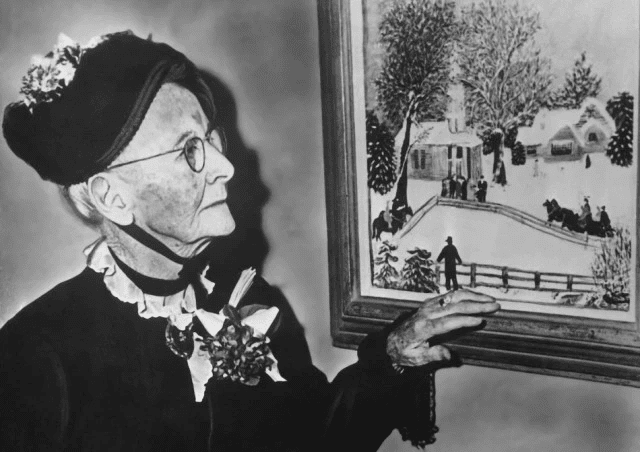
Anna Mary Robertson was born on September 7, 1860, in Greenwich, New York. Her father was a farmer who processed flax, and her mother helped him with the household. The family had ten children, and there weren’t enough funds to provide them with a formal education.
However, Anna did attend a local school for a short time, and she particularly loved art classes. The girl was captivated by drawing, but her parents couldn’t afford pencils. So, Anna got creative, drawing with lemon and grape juice, grass, ground ocher, and slaked lime.
At 12, she started working as a housekeeper for a wealthy neighboring family. Anna continued this work for the next 15 years. One of her employers noticed her passion for drawing and bought her chalk and wax crayons. This allowed her to draw in her free time, though she had no idea then that her drawings would one day bring her global fame.
Personal Life
At 27, Anna married Thomas Moses, who worked with her on the farm. He was offered a job at a horse farm in North Carolina, so the couple set off. However, they never reached their destination, settling instead in Staunton, Virginia.
For the next two decades, the couple worked on local farms. Anna bought a cow and churned butter from its milk, and she also made potato chips to sell. The couple had ten children, but only five lived to adulthood.
The couple managed to save enough money for their own small farm, Mount Airy, near Verona, Virginia, where they settled in 1901. Four years later, the family returned to the northeastern U.S. and settled on a farm in Eagle Bridge, New York.
In 1927, Anna’s husband suddenly passed away after a heart attack. She never remarried. In 1936, she moved in with one of her daughters’ families.
Anna Moses’s Artistic Journey
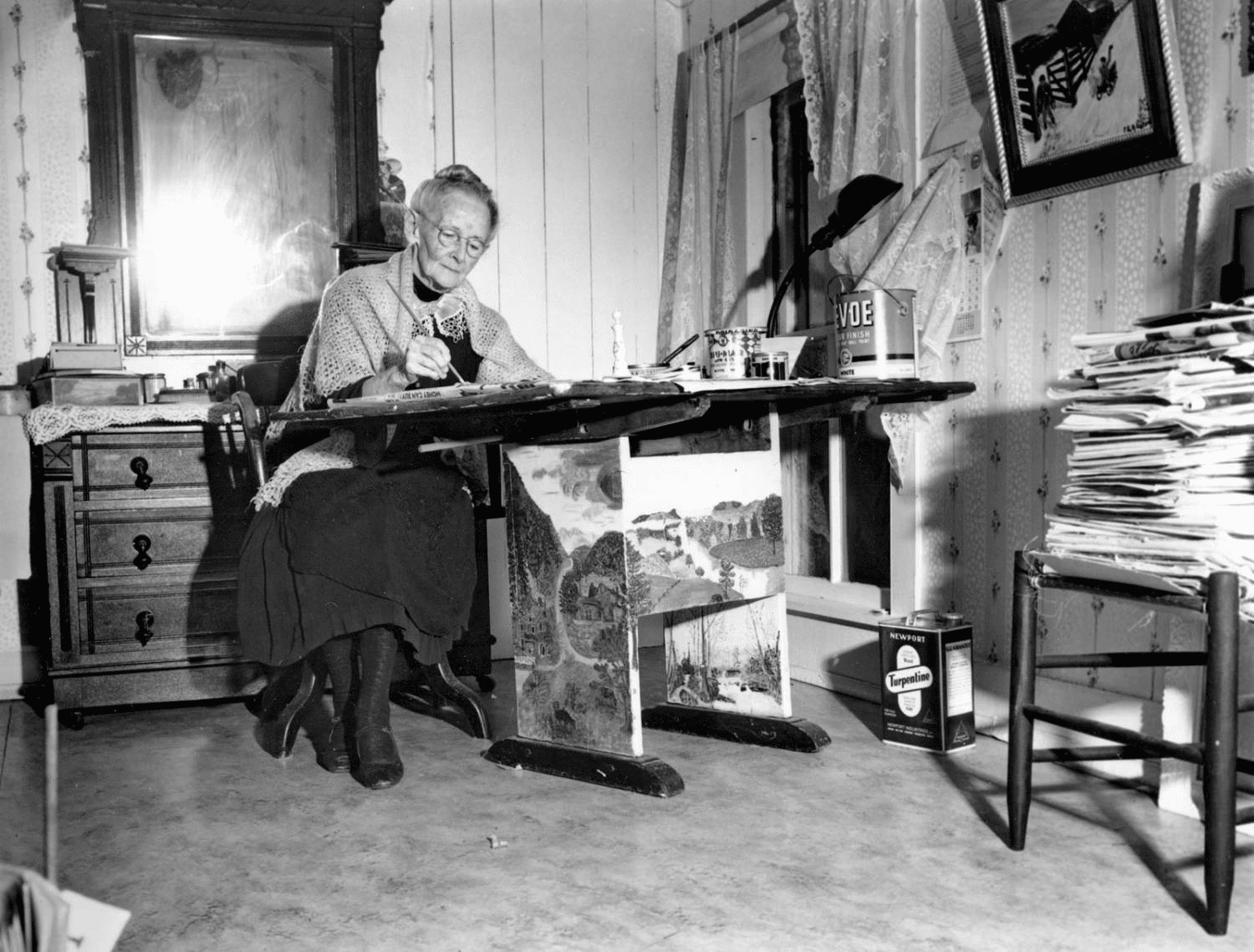
A desire for creative expression was always present in Anna Moses’s life. When she was setting up her first family home, she personally painted the fireplace mantel. With a bit of free time, she would create various charming little trinkets and draw.
In 1932, she developed a passion for embroidery. Anna Moses created yarn pictures for friends and family. However, a few years later, her arthritis worsened, and she could no longer embroider. That’s when one of her sisters suggested she return to painting. She painted with both hands, and at the age of 78, she officially began her art career.
Anna invented the artistic pseudonym “Mother Moses,” although her first exhibitions were held under the name “Mrs. Moses.” Due to her advanced age, the press once referred to Anna as “Grandma Moses,” and this nickname stuck.
Her work first gained public attention in 1940. Over the next two decades, the artist created over 1,500 canvases, completing her last painting, “The Rainbow,” when she was over 100 years old.
Artistic Career and Recognition
Anna Moses is known as a folk artist because she had no formal art education. Her works are generally divided into early and late periods, tracing her evolution from copying popular prints to developing her unique style.
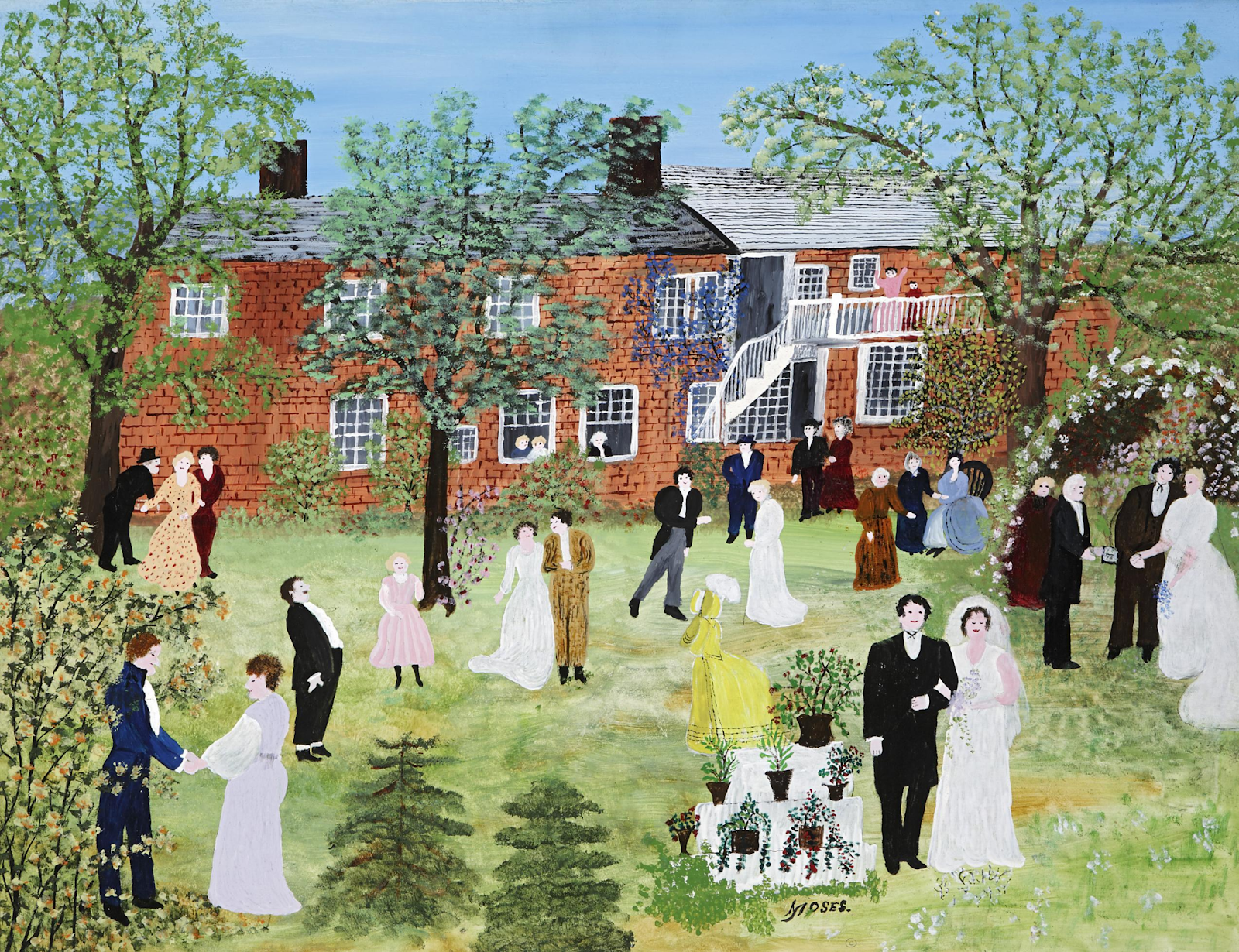
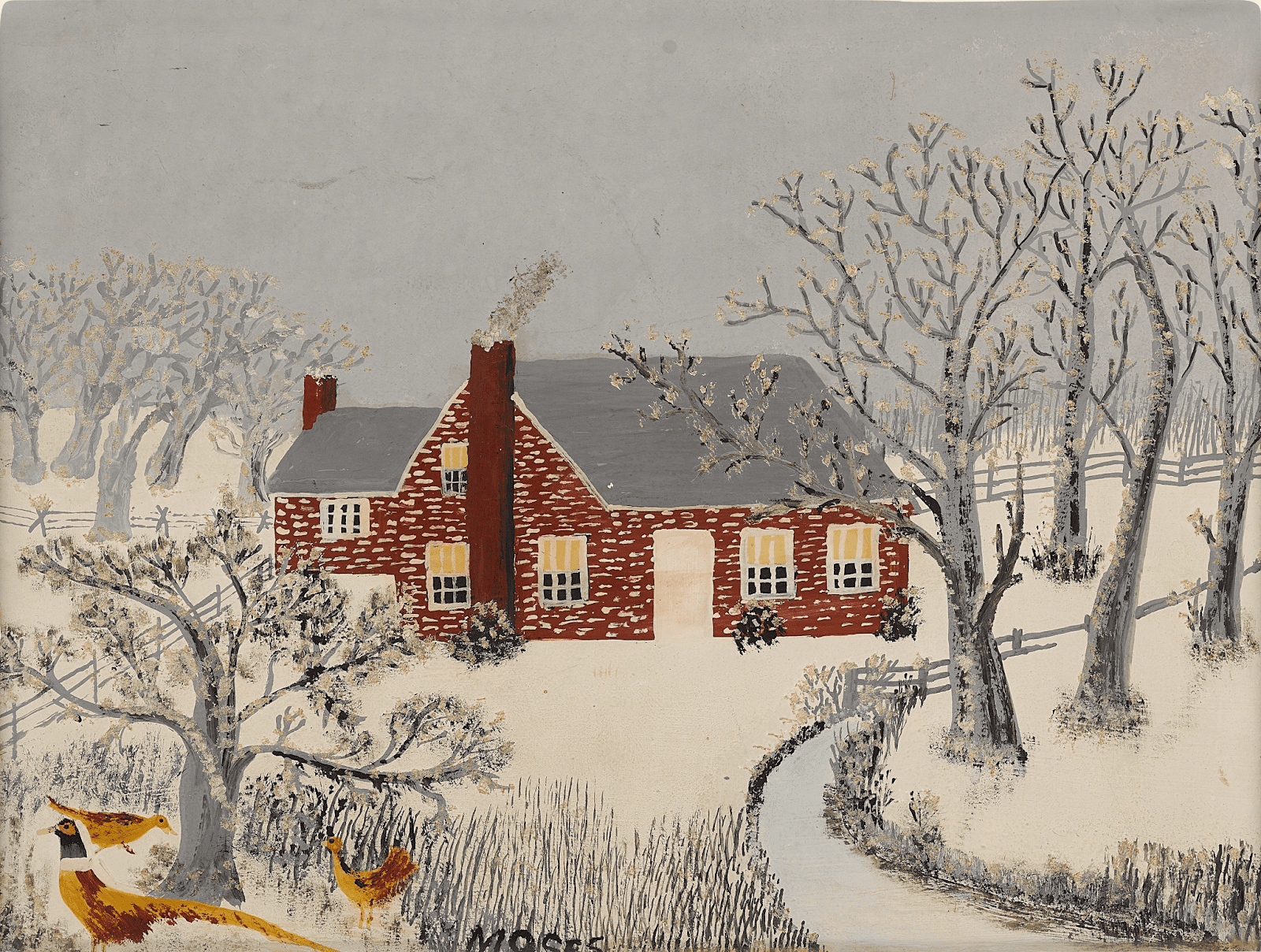
Early paintings by Anna Moses are less individual and realistic. She created simple compositions or copied ones she saw. Over time, the artist transitioned to depicting complex panoramic compositions of rural life. Notably, she never included signs of technological civilization in her works. Viewers won’t see power poles or wires, tractors, or airplanes in the sky in her paintings. Instead, Grandma Moses depicted horse riders, horses harnessed to buggies or carriages. A recurring theme in her work was a deep respect for labor, local history, and nature, as well as a love for fun and festivities.
Anna Moses’s drawings were first purchased by collector Louis Caldor in 1938, who saw them in a pharmacy window during a visit to Hoosick Falls. He then found the artist and bought ten more of her works, paying up to $5 for each. The following year, Caldor convinced the Museum of Modern Art in New York to include three of Moses’s drawings in the exhibition “Contemporary American Artists,” and then organized an exhibition for her at the Galerie St. Etienne.
Anna Moses’s first solo exhibition opened in New York on October 9, 1940. In November, a second exhibition and a meeting with the artist were held at Gimbel’s department store. After this, her paintings began to be displayed at other exhibitions in the U.S. and abroad. Anna Moses’s popularity began to soar, as did the number of people wanting to buy her works.
Initially, the artist charged $3 to $5 per painting, but eventually, her works were sold through “Grandma Moses Properties, Inc.,” valued at $8,000 to $10,000. In 2006, her 1943 painting titled “Sugaring Off” sold at Christie’s auction in New York for $1.2 million.
Grandma Moses quickly became a popular figure in the 1950s art scene. Her exhibitions, as well as her personality, captivated not only Americans but also the entire world. The artist received significant recognition:
- In 1949, President Harry Truman awarded her the Women’s National Press Club award for outstanding achievement in art.
- In 1950, the National Press Club named Moses among the top five women in the U.S. worthy of constant media attention.
- The National Association of Home Fashions Manufacturers recognized her as “Woman of the Year 1951.”
- She was also honored with two honorary doctorates – from Russell Sage College in 1949 and from Moore College of Art and Design in 1951.
In 1950, a documentary film about the artist’s life was made, earning an Academy Award nomination. Two years later, Anna Moses published her autobiography, “My Life’s History,” and in 1953, she appeared on the cover of Time magazine. She was frequently invited to television shows and programs, interviewed, and featured in newspapers and magazines.
The Death and Artistic Legacy of Grandma Moses
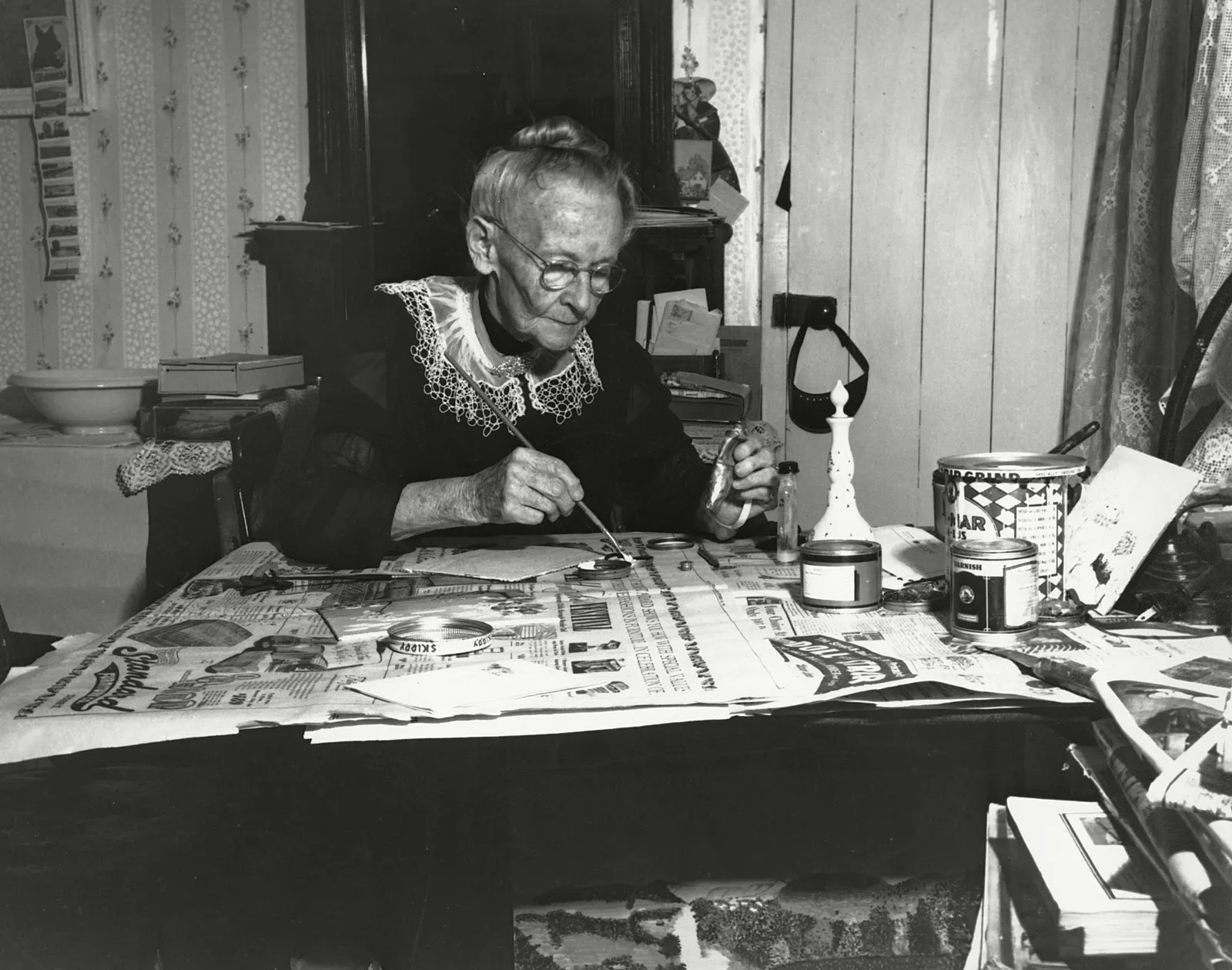
The renowned artist passed away on December 13, 1961, at the Health Center in Hoosick Falls, at the age of 101. She was buried in Maple Grove Cemetery, and her memory was honored by U.S. President John F. Kennedy.
After the artist’s death, her works were exhibited in major traveling exhibitions across the U.S. and abroad. Interest in them continues into the 21st century. For example, her 1942 painting “The Old Checkered House,” originally purchased for less than $10, was valued at $60,000 at a Memphis exhibition in 2004.
In 1969, the U.S. issued a commemorative stamp honoring the artist, featuring her painting “Fourth of July.” This work was gifted to the White House in 1952 by Otto Kallir of Galerie St. Etienne.